Carbon Monoxide Dangers in Your Home

FurnaceBrr! It’s getting cold outside. It’s the time of year to turn on your furnace or heaters to stay warm.

Did you know many heating devices can produce dangerous levels of carbon monoxide, a colorless and odorless gas, that can quickly incapacitate and kill you? More than 400 persons die each year from carbon monoxide poisoning.

Sources of carbon monoxide in addition to malfunctioning furnaces and room heaters include cars, malfunctioning fuel burning appliances such as ranges and water heaters, and engine powered equipment such as portable generators. Burning charcoal in fireplaces inside the home or semi-enclosed areas can also result in lethal levels of carbon monoxide poisoning.

Modern furnaces performance to vent carbon monoxide does not always provide consumer protection from carbon monoxide leakage under a number of conditions that commonly occur. These conditions include disconnected vents, partially blocked vents, over-fired furnaces, and furnaces that have inadequate air for combustion. These common scenarios underscore the need to provide consumers with more comprehensive protection against carbon monoxide poisoning.

Following the safety hierarchy, it is always best to eliminate a hazard of carbon monoxide through design, to the extent reasonably possible. Any remaining hazards need to be guarded against, to the extent reasonably possible. However, as consumers, the most immediate action we can take is to provide in our homes and perhaps work places carbon monoxide detectors/alarms.

Look around in your home. Do you have carbon monoxide detector(s)/alarm(s)? If so, have you replaced the batteries and ensured they are in functioning order?

For more information on carbon monoxide poisoning, please visit the CPSC website.

Unavailing Safety Slogans

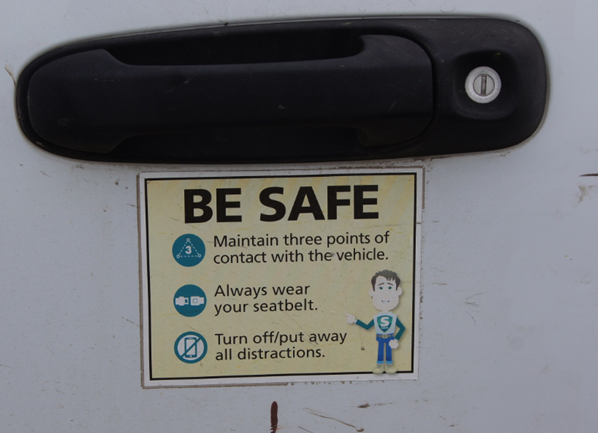
Safety Slogan Door Sign“Be Safe.” “Stay Alert.” “Drive Safely.” “Choose Safety.”

Safety slogans are abundant. Many are also abundantly unclear and ineffective.

The picture to the right is a sign on the door handle of a service truck. It provides an excellent example of why safety slogans are ineffective. Each slogan also demonstrates how product designs can be updated to include important systems, making safety slogans unnecessary.

First, this slogan does nothing to identify or eliminate hazards. The wording “maintain three points of contact with the vehicle” can be eliminated by incorporating near object detection devices into the vehicle during the design.

Second, the wording “always wear your seat belt” is not necessary if you have a system which has a constant buzzing noise or perhaps ignition interlock which prevents the vehicle from starting until the seat belt is engaged.

Third, the wording “turn off/put away all distractions” is not necessary if you have a system that blocks the phone signal (absent an emergency) while the vehicle is in operation. Perhaps this system would not be popular with consumers. However, humans have very poor divided attention abilities.

Fourth, if the poorly thought out slogan is to be used on this service truck, why is it on the outside by the door handle and not the inside to provide a constant reminder to the driver?

So, what does “be safe” really mean? This is the problem with poorly thought out slogans. The slogans are subject to various interpretations.

Safety is not common sense. What is common to you may not be common to another person. Safety, a science that identifies hazards, risks, and safety engineering alternatives, cannot be addressed by vague safety slogans. Safety begins long before a product or system reaches consumers.


A Very Safe and Happy Thanksgiving

Kitchen FireIt’s that time of year. Turkeys, families, football…Thanksgiving Day is almost here. This is supposed to be a day for us to enjoy our families and celebrate all we’ve been given.

Unfortunately, there are approximately 1400 house fires on Thanksgiving day every year. Why do household fires triple on this special day? How can you keep safe? Listen in as Kevin King discusses the risks that occur on Thanksgiving and what steps you can take to keep yourself, your loved ones, and your home out of the statistics book.


Want to hear more talks from Peter and Kevin King? Tune into WCIS 1010 AM Columbus, IN the first and third Friday of every month for People’s Law Talk.


History of Lobbyist

Capital Hill We’ve all heard the word “lobbyist.”

The definition of a lobbyist is a group or person that analyzes regulation/regulatory proposals, attends congressional hearings, and informs government official about various matters of proposed legislation.

What do lobbyist have to do with safety, specifically, your safety? Legislators cannot know everything. However smart they are, there is no way for them to know everything about every topic they must pass laws and regulations over. That’s where lobbyist come in. One part of a lobbyist’s job is to be there to help inform legislators on a variety of topics, including those laws concerning product designs and safety regulations.

So where did lobbyists come from, how are they regulated, and who is spending the most money to hire the more than ten thousand lobbyists registered in Washington D.C.?

Listen in as Kevin King, counselor from Cline, King & King, discusses the history of lobbyist. Talking with John Foster on WCIS 1010 AM in Columbus, IN, King explores where lobbying developed, lobbyist regulation, spending for lobbyist, and some murkiness that surrounds lobbyist in the political arena.


Want to hear more talks from Peter and Kevin king? Tune into WCIS 1010 AM Columbus, IN the first and third Friday of every month for People’s Law Talk.


Cord Blind Strangulation is Happening

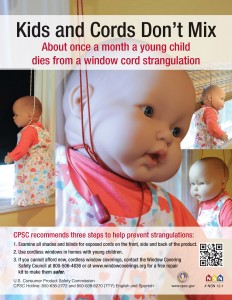
Kids & CordsInfants and young children are dying on a monthly basis due to corded blinds. WHY? That is one child too many every month.

The Consumer Product Safety Commission (CPSC) has issued a statement calling for removal of corded blinds from homes and the marketplace due to numerous, unacceptable infant deaths and serious injuries.

Designers, manufacturers, and distributors of corded blinds blame parents and others for the deaths and serious injuries to infants. Those same designers, manufacturers, and distributors should have known of hazards, risks, and dangers of their corded blind products. Instead they turn a blind eye and blame human err instead as they continue to market their deadly products.

Cut out the blaming of parents. The focus should be on hazard and risk analyses of corded blinds. Part of these analyses requires anticipation of how and in what manner a product will be used. Human err, if any, must be accounted for in the design of products. Designers must change the design to the extent reasonably possible to eliminate potential human err with the product.

Informational literature in a box and/or a warning is inadequate if hazards can be reasonably eliminated through design. A warning is not an acceptable solution if a product can reasonably be designed in a safer manner.

Remember, any risk of death or serious injury is unacceptable if reasonable prevention measures could eliminate the death or injury. Reasonable prevention begins with the design, long before a product reaches the hands of consumers.


Veterans Day and System Safety

Thank You From CKKIn remembering those individuals who served our country in the armed forces, did you know that system safety had its origins from the military?

During World War II, it was determined military aircraft was lost more to incidents unrelated to combat than in actual battle. Why did this occur? Analyses were undertaken to determine if systems could be designed better to prevent loss of life and/or serious property damage.

Later, in 1969, MIL-STD-882 was published. It provided guidance and outlined systematic understanding of safety. The concepts of MIL-STD-882 were not limited to military applications, but could be applied to systems impacting the lives of civilians.

In MIL-STD-882, it defined safety as “freedom from those conditions that can cause injury or death to personnel, damage to or loss of equipment or property.” As you remember those brave individuals who fought to preserve our freedom, also remember our military provided freedom for a safer society with development of system safety.

Thank you to all of our active and veteran service personnel for a free and safe society!