
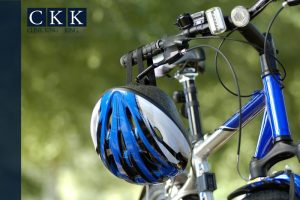
Riding Safe: Selecting a Bicycle Helmet

Bicycle Helmet SafetyReady to cruise on your bicycle? Not without a helmet you’re not.

The Center for Disease Control and Prevention reported that nearly half a million emergency room visits in 2013 were due to bicycle related injuries. Although not all of these injuries were head injuries, approximate 75 percent of 700 bicycle deaths each year are related to head injuries.

With the risk of head injuries significant, it is vital to wear a properly fitted helmet. Helmet use has been estimated to reduce the odds of head injury by 50 percent. Incredibly, only 21 states and the District of Columbia require helmets, but only of persons 17 years of age and younger.

Whether required by law or not, you need to be wearing a helmet on your bicycle. Selecting a bicycle helmet can be a daunting task to those outside the cycling industry as necessary information is not readily available and sometimes confusing. Bicycle helmets are marketed online, large retail stores, and bike shops. Prices can be very significant. With different styles and price ranges, what should you consider when purchasing an important aspect of bicycle safety?

One of the best sources of information is the Snell Memorial Foundation. Snell is a non-for-profit foundation working to provide information and independent testing of sport helmets, including bicycle helmets. When a helmet has been approved by Snell, there will be a Snell sticker inside the helmet. Consumers should look for a helmet that has been tested by Snell.

Snell testing covers four areas:

  1. Impact Management: This determines how well the helmet protects against collisions with large helmets.
  2. Positional Stability: This determines whether the helmet will be in place on the head in the event of a collision.
  3. Retention Strength: This determines whether the chin straps will sufficiently hold the helmet throughout the head impact.
  4. Overall Protection: This determines extent of protection to the head by the helmet.

Most consumers will find a label inside a helmet maintaining that the helmet meets Consumer Product Safety Commission Standard of March 1999. Snell testing augments the CPSC standard.

When you’re ready to purchase your helmet, it is suggested to purchase bicycle helmets from a dedicated bicycle shop. More likely true than not, bicycle shops will be familiar with proper fit and Snell approved helmets. Also strongly consider a helmet color that increases the cyclist visibility to motorists and pedestrians.

Besides Snell, www.helmets.org is also a good resource for learning about bicycle helmet safety.
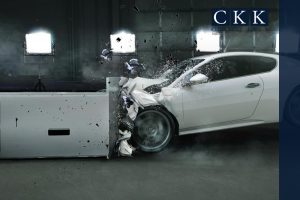

Vehicle Crash Tests Ratings: What You Need to Know

CrashTestingReady to buy a new car? You’re probably considering three big factors when making your purchasing decision: cost, style, and safety. Though sometimes looked at last by consumers, safety should be at the forefront of your mind as you make your purchase.
A new vehicle is something you’re going to spend time in on a daily basis. You need to trust your car to get you from point A to point B without worrying about what will happen to you should there be a crash. One way to know the safety of a vehicle is to look into crash test ratings. Where do you find this crash test data and how do you know what each crash test is studying? Listen in as Kevin King explains the safety behind vehicle crash tests.

Want to hear more talks from Peter and Kevin King? Tune into WCIS 1010 AM Columbus, IN the first and third Friday of every month for People’s Law Talk.


The Decision Is…

Supreme CourtSplit. Since 1925 there have been 140 split decisions handed down for the United States Supreme Court. With an open Supreme Court Justice seat, it’s happening again.

Recently, there were split decisions on a union case from California and a case involving mortgage companies holding spouses liable. With only eight justices currently working, split decisions are bound to happen again on upcoming cases covering important matters including immigration and healthcare.

So what does a split decision mean? And is there a way to fix this until a new justice is appointed? Listen in as Kevin King discusses the important matter at hand.

Want to hear more talks from Peter and Kevin King? Tune into WCIS 1010 AM Columbus, IN the first and third Friday of every month for People’s Law Talk.


Cyber Threats Leave Vehicles Vulnerable

Car TechnologyWe have become reliant upon Bluetooth, WIFI, USB devices, and intelligent traffic communications within our vehicles. These features can improve fuel economy, reduce driver fatigue, and increase traffic safety, but it is all at a cost. Increased technologies can allow for dangerous breaches of security in vehicles. The Federal Bureau of Investigations and NHTSA recently published an alert regarding this automotive cybersecurity. 

Vulnerabilities may exist within wireless communication functions of a vehicle allowing an attacker to gain access to vehicle systems. In August 2015, a vehicle was studied in an unaltered condition which allowed cyber-attacks to affect engine speed, brakes, steering, door locks, turn signals, radio, and GPS. Obviously, this is disturbing to consumers who have advanced electronics in their vehicles. The bulletin by the FBI and NHTSA while providing important information, did not address why this could occur or how it would be prevented.

Software safety is not only a software issue, it is a system issue. Software related hazards must be identified, understood, and mitigated considering that software interfaces with hardware, humans, and other software. Software safety is an integral aspect of the overall system safety plan and the methodology is documented in a system safety plan process.

Software safety is not the same as software reliability or quality assurance. A pragmatic way to determine software safety is by incorporating a bilateral safety process.

First, software functional coverage is a process focusing on functional design and hazard identification. Secondly, software development coverage focuses on specific development tasks to ensure high quality software is safe. The bilateral approach is a strategy intended to cover all aspects of software that can impact safety. The approach requires a system hazard analysis to identify hardware and software causal factors, identification of software at critical levels which will impact the level of rigor tasks performed by the software development effort.

With each model year, vehicles become more integrated regarding communications. It is necessary for designers and manufacturers of intelligent transportation systems to undertake system safety planning of software to identify and eliminate said hazards to the extent reasonably possible.


Politics: The More Things Change, the More They Stay the Same

NewspapersThe 2016 Presidential election is in full swing and, unless you have cut yourself off from the outside world, you’ve been privy to a front row seat of the unfolding battle. A big story playing out in this year’s election process is the split in the Republican Party. On a regular basis there is news about presidential candidate Donald Trump against Candidate X or against Candidate Y. The recurring theme is Trump against the rest.
For many, seeing the party split may be a new experience. There has not been a major party contention such as this for many decades. But, if you search through the history books, you’ll find it’s a tale told over and over again. The more things change, the more they stay the same, politics not excepted.

Listen in as Kevin King discusses political upheaval and party splits of the past, starting with the first party split of the Democrat-Republican party in the early 19th century.

Want to hear more talks from Peter and Kevin King? Tune into WCIS 1010 AM Columbus, IN the first and third Friday of every month for People’s Law Talk.


A Daily Struggle: Tethering Child Safety Seats

Daily, moms and dads across the country place their most precious cargo into a child safety seat and hit the road, all of them believing their children are safe and secure. With mandatory laws requiring that children be placed in car seats, two systems (seat and car) come into play and interact with one another. This interaction of a child safety seat with a vehicle is another example of how system safety can be used to recognize hazards and eliminate said hazards through design.

Over the years, there has been literature regarding parents’ alleged misuse of car seats relative to installation anchoring. Misuse is the incorrect term though. Parents use their best efforts to anchor car seats given the two systems they are utilizing. Designers of the systems (both car seat designers and car designers) should undertake studies well in advance of marketing to understand how parents will use both systems in conjunction.

In 2015 the Insurance Institute for Highway Safety published a study regarding LATCH (Lower Anchors and Tethers for Children). The study found that latch hardware could be better designed for correct installation. The study recognized that parents often struggled to locate the anchors in vehicles or find it difficult to attach the car seat to the vehicle.

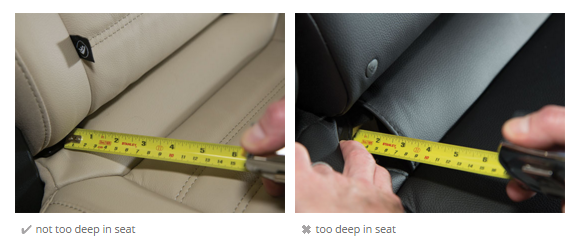
Lower anchors should be no more than ¾ inch deep in the seat bight (area where the seat back and base come together). 

Seat Bight Measurements

The left picture shows a depth of less than ¾ inch. The right picture shows a depth of greater than ¾ inch.

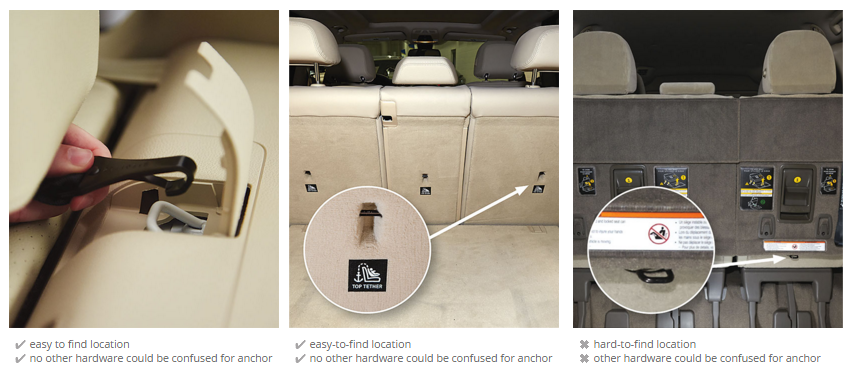
Upper anchor points should also be easy to find, clearly labeled, and not confused with such things as cargo hooks that could be mistaken for anchor points.

Seat anchor examples

The two left images show vehicles with easy to find anchors without other hardware nearby that could be confused as anchors. The right image shows tethering anchors that are hard to find. They are hidden among other hardware that could easily be confused as anchors.

Securely anchoring child seats should not be a struggle for parents. Coordinating designs of child seats relative to vehicles is an example of how design induced error can occur when system safety is not used.